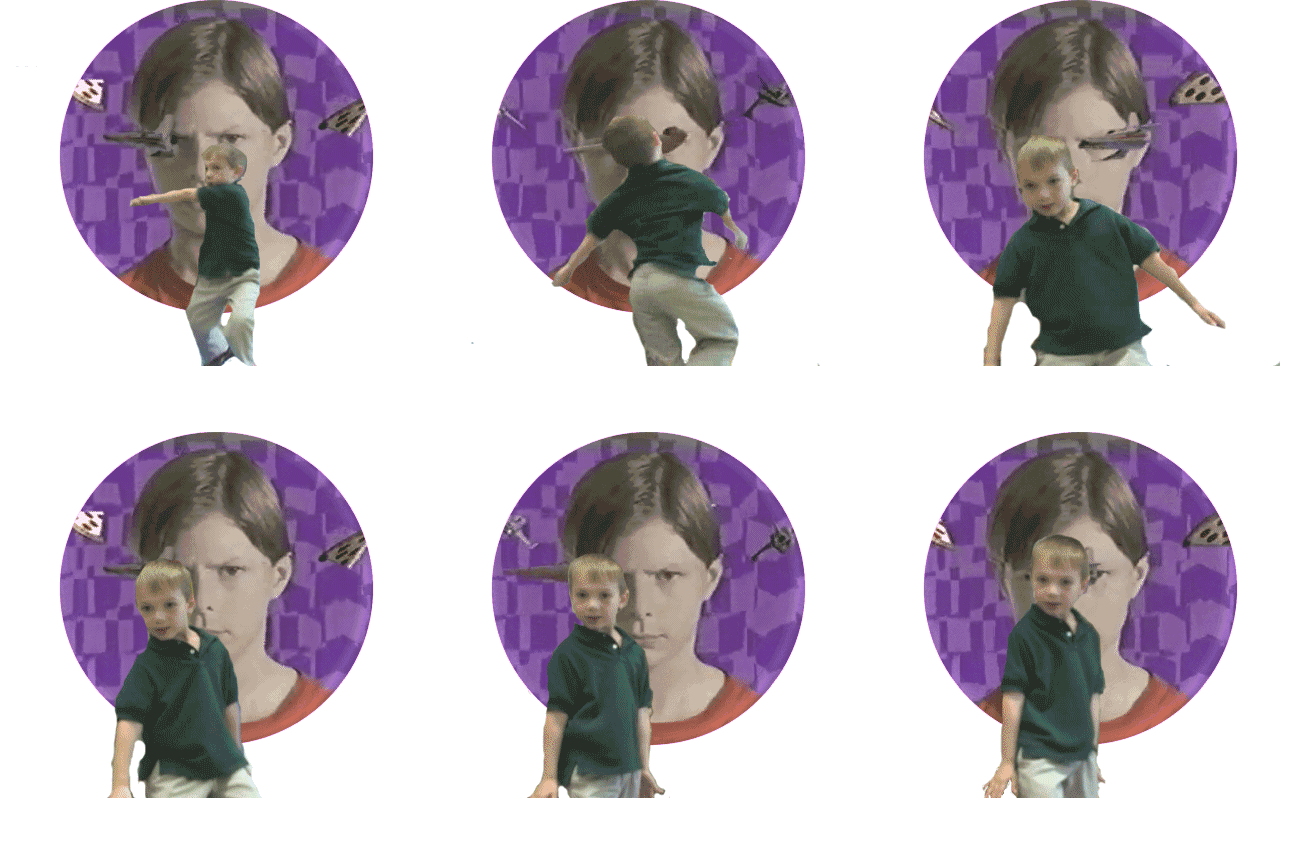
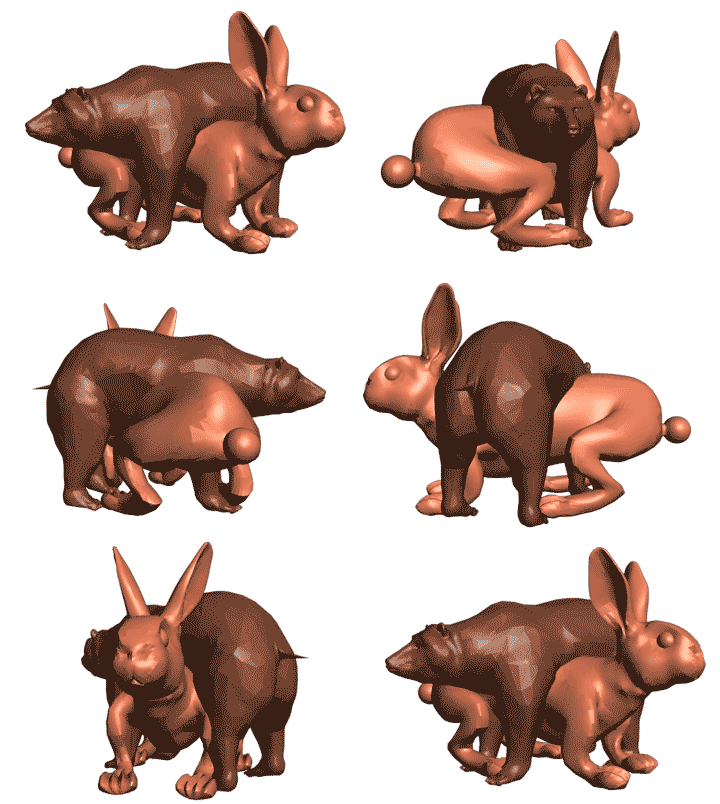
I am influenced by artists and popular culture that have an anthropomorphic, humorous and wonky aesthetic. I want to explore the relationship between the elements of error, chance, anthropomorphism and humour in my own practice considering how the connections and relationships between these elements can be enhanced.
Tuesday, August 13, 2013
Bisous Les Copains
On the Smashing Magazine newsletter I found a link to a Tumblr page that has weekly animated Gifs by Guillaume Kurkdjian. They are based on characters from a virtual world and depict everday scenes from their lives.
Well designed and executed, they are simple, thoughtful and artistic. Together they begin to tell a story about the world where these characters live. A story of gif moments.
http://bisouslescopains.tumblr.com/
Saturday, August 3, 2013
The Doctrine of the Similar (GIF GIF GIF)
This article written by Daniel Rourke. He is currently undertaking a practice based PhD in Art at Goldsmiths. His research explores human error and the digital through the ontology of writing.
Email: d.rourke@gold.ac.uk
This article written by Daniel Rourke. He is currently undertaking a practice based PhD in Art at Goldsmiths. His research explores human error and the digital through the ontology of writing.
Email: d.rourke@gold.ac.uk
UPDATE: Published in issue 3.1 of Dandelion Journal, on ‘Brevity’
In two short essays – written in 1933 – Walter Benjamin argues that primitive language emerged in magical correspondence with the world. The faculty we all exhibit in childhood play, to impersonate and imitate people and things loses its determining power as language gradually takes over from our “non-sensuous” connection with reality. In a break from Saussurian linguistics, Benjamin decries the loss of this “mimetic faculty”, as it becomes further replaced by the “archive of non-sensuous correspondences” we know aswriting.
To put it in simpler terms… Where once we read the world, the stars or the entrails of a sacrificed animal, now we read the signs enabled and captured by written language.
From Benjamin’s The Doctrine of the Similar:
“So speed, the swiftness in reading or writing which can scarcely be separated from this process, would then become… the effort or gift of letting the mind participate in that measure of time in which similarities flash up fleetingly out of the stream of things only in order to become immediately engulfed again.”
The GIF – standing for Graphical Interchange Format – has been around since 1987. Their early popularity was based, in part, on their ability to load in time with a web-page. In the days of poor bandwidth and dial-up connections this meant that at least part of a GIF image would appear before the user’s connection broke, or – more significantly – the user could see enough of the image for it to make sense. In the mid 90s avid web hackers managed to crack the code of GIFs and use this ‘partial loading’ mechanism to encode animations within a single GIF file. Thus the era of personal web pages saturated with looping animations of spinning hamsters was born.
Brought on – ironically – by their obsolescence the GIF has become the medium of choice for web artists, propagating their particular net-aesthetic through this free, open and kitschy medium. GIFs inhabit the space between convenience and abundance, where an apparent breakdown in communication can stimulate new modes of expressing non-sensuous similarities in the internet world.
Sites like dump.fm, 4chan and ytmnd revel in the GIF’s ability to quickly correspond to the world. GIFs can be broken into their constituent frames, compressed and corrupted on purpose and made to act as archives for viral events travelling the web. A playground ofcorrespondences that at first reflected language and the wider world now looks increasingly inward. Finding meaning in the semiotic sludge of these GIFs requires a sensitivity to similitude bordering on the magical.
GIFs take a variety of forms, some of which I will try to classify here:
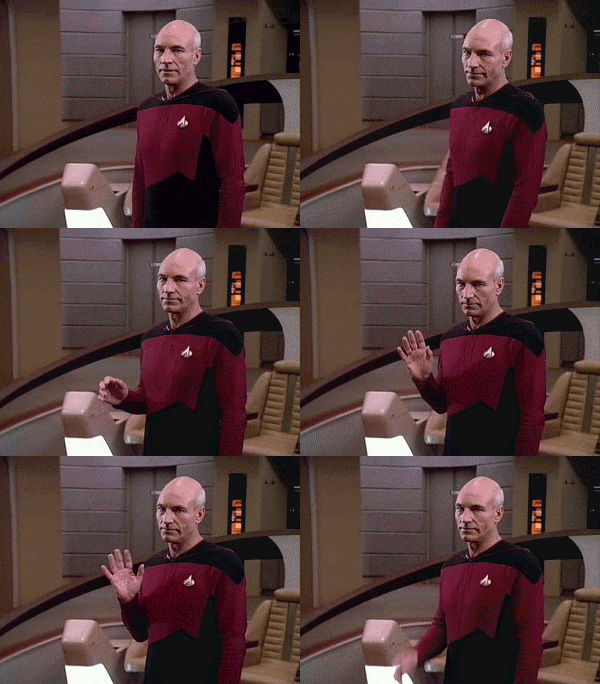
GIF Type I: Classic
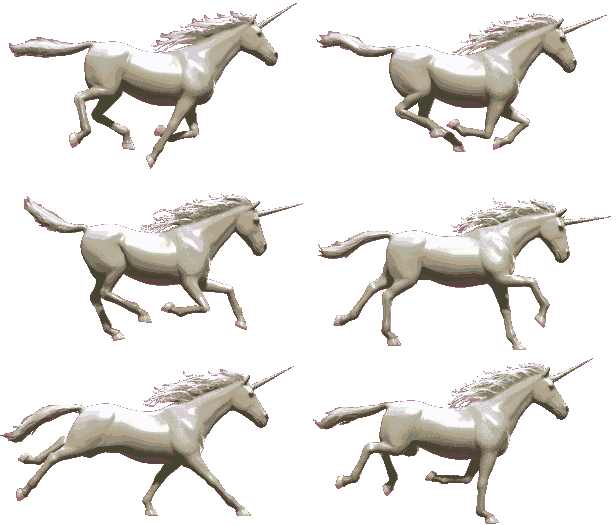
Small in size and made up of few frames, this is where animated GIFs began. Corresponding to single words or concepts such as ‘smile’, ‘alien’ or ‘flying pink unicorn’.
GIF Type II: Frame Capture
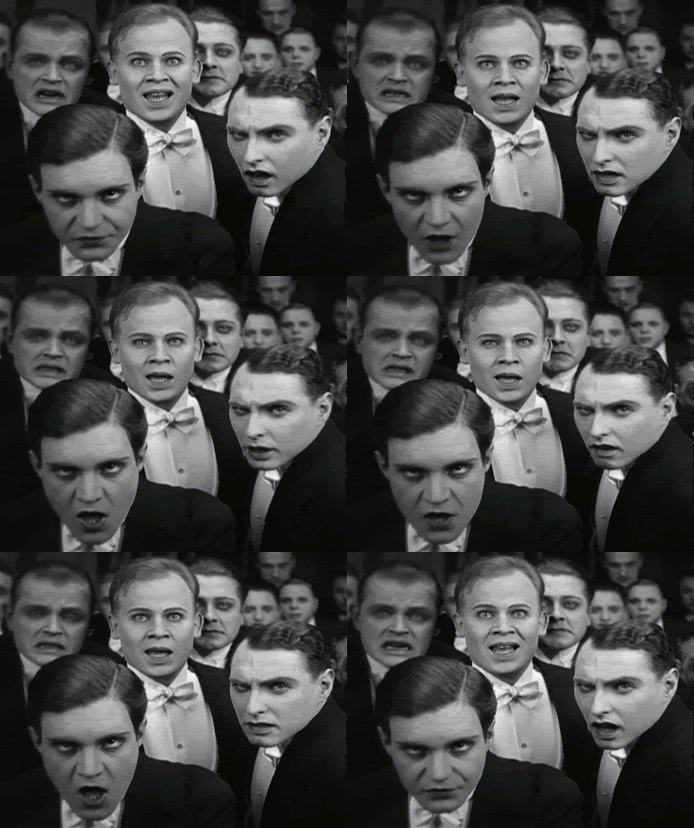
Frame grab or video capture GIFs pay homage to well known scenes in pop culture. But as the ‘art’ of animated GIFs grew the frame capture began to stand for something isolated from context. This leap is, for me, the first point at which GIFs begin to co-ordinate their own realm of correspondence. An ocean of viral videos turned into a self-serving visual language, looping back on itself ad infinitum.
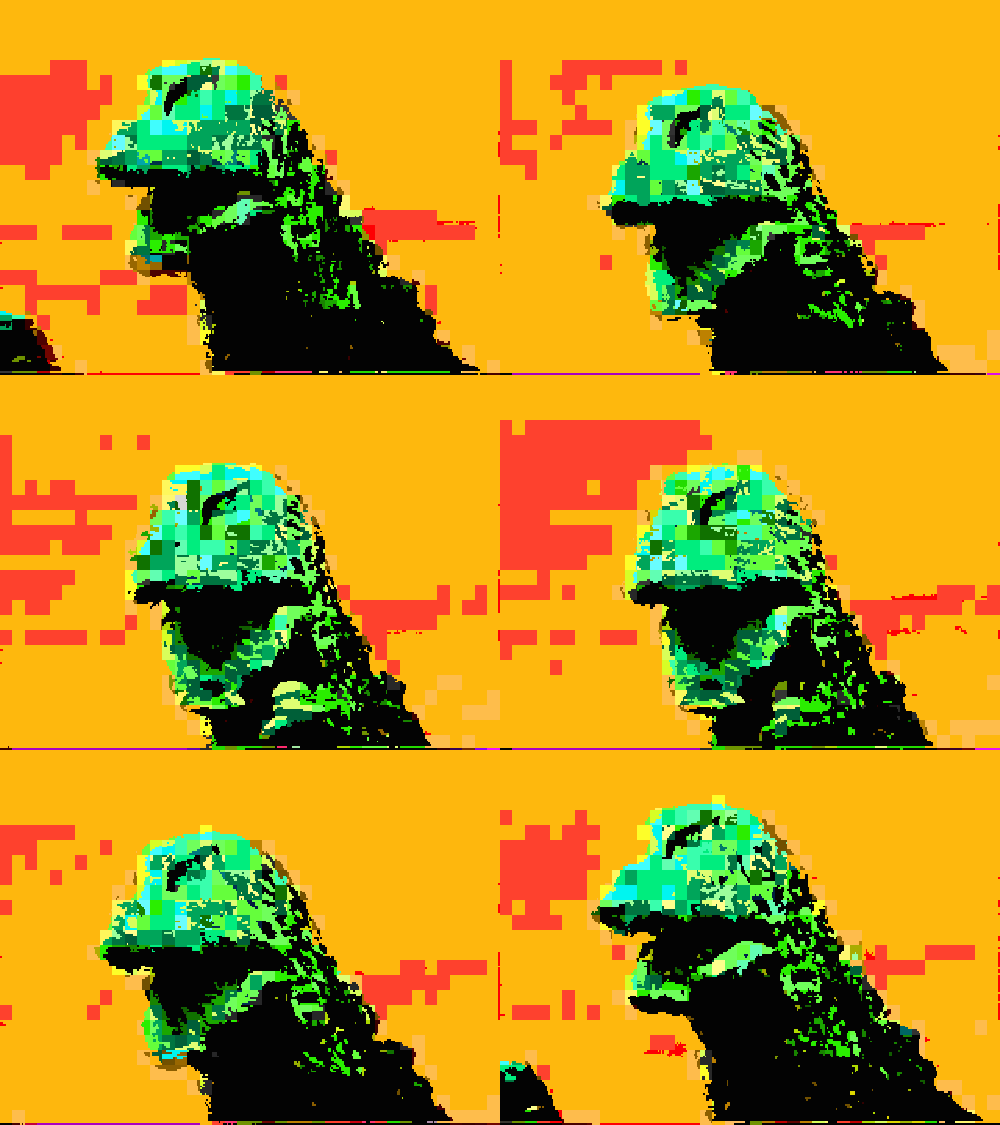
GIF Type III: Art
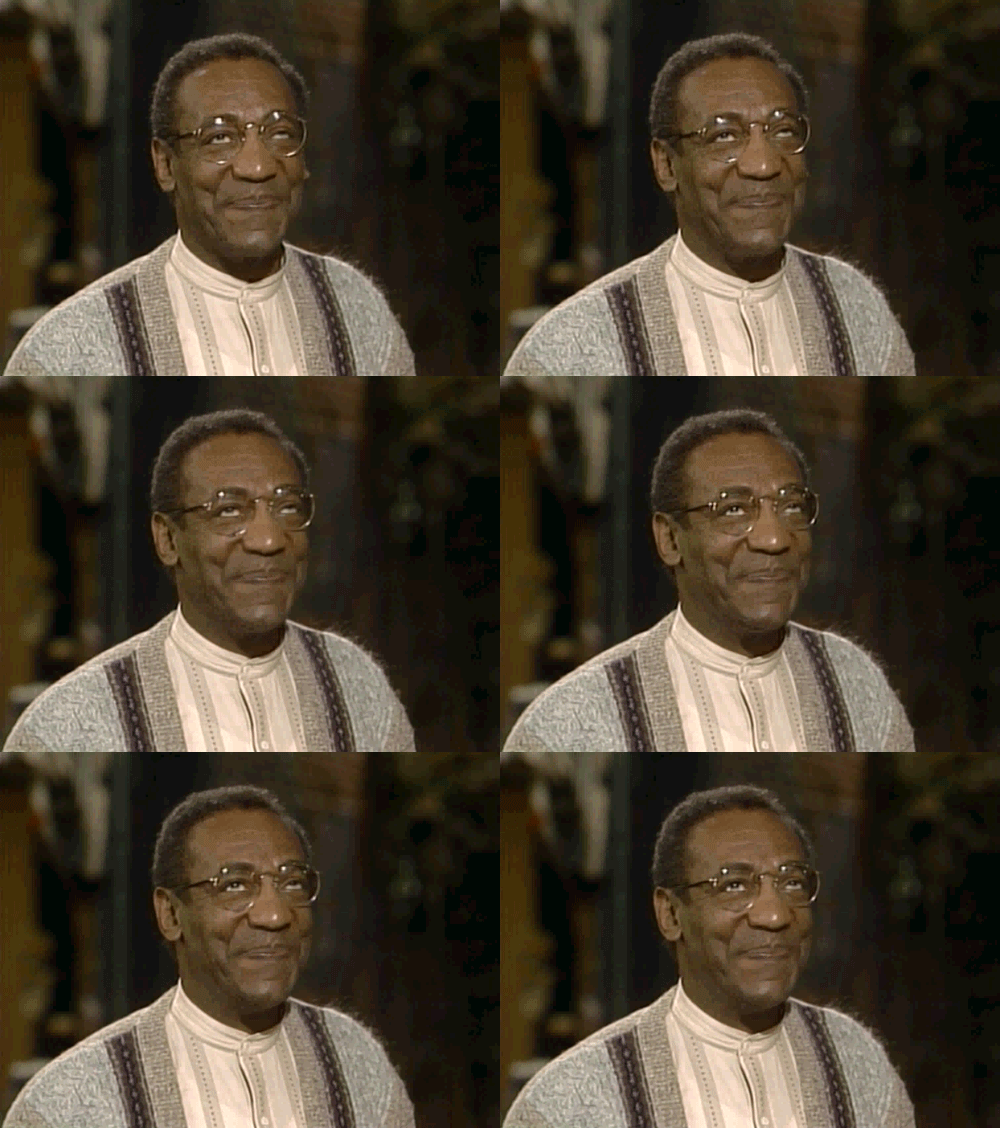
Leaking then directly into the third category, we have the Art GIF. Much larger in resolution and aware of their heritage in cinema, these GIFs are acutely refined in their choice of framing.
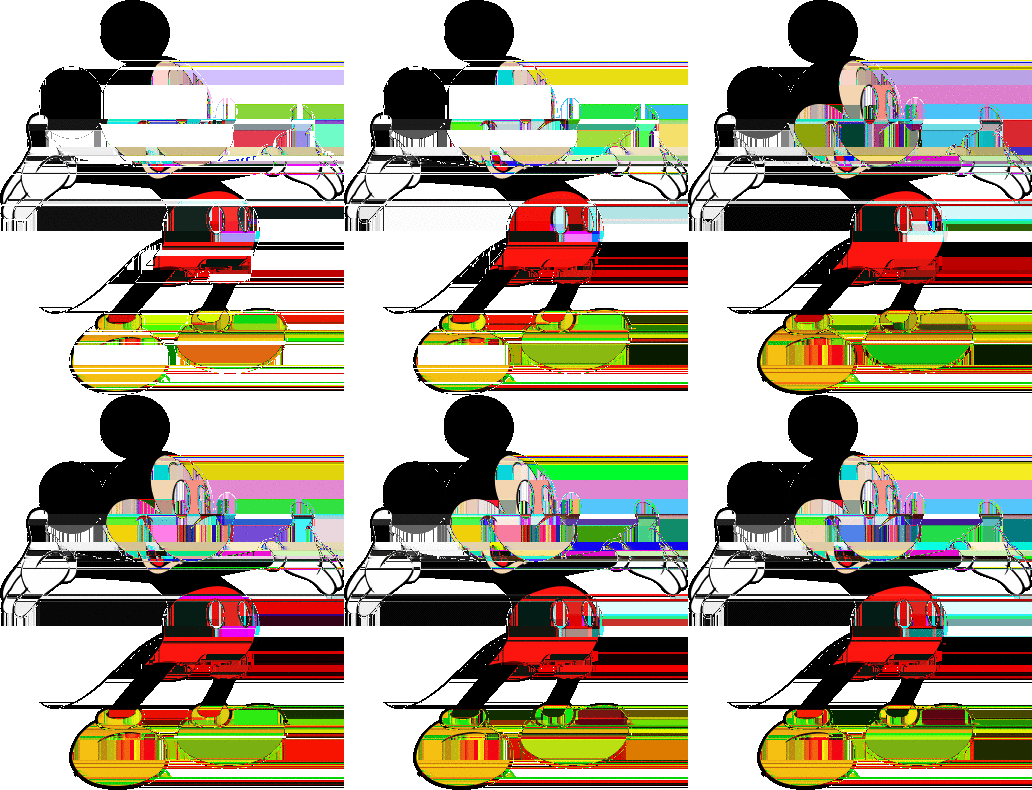
GIF Type IV: Glitch
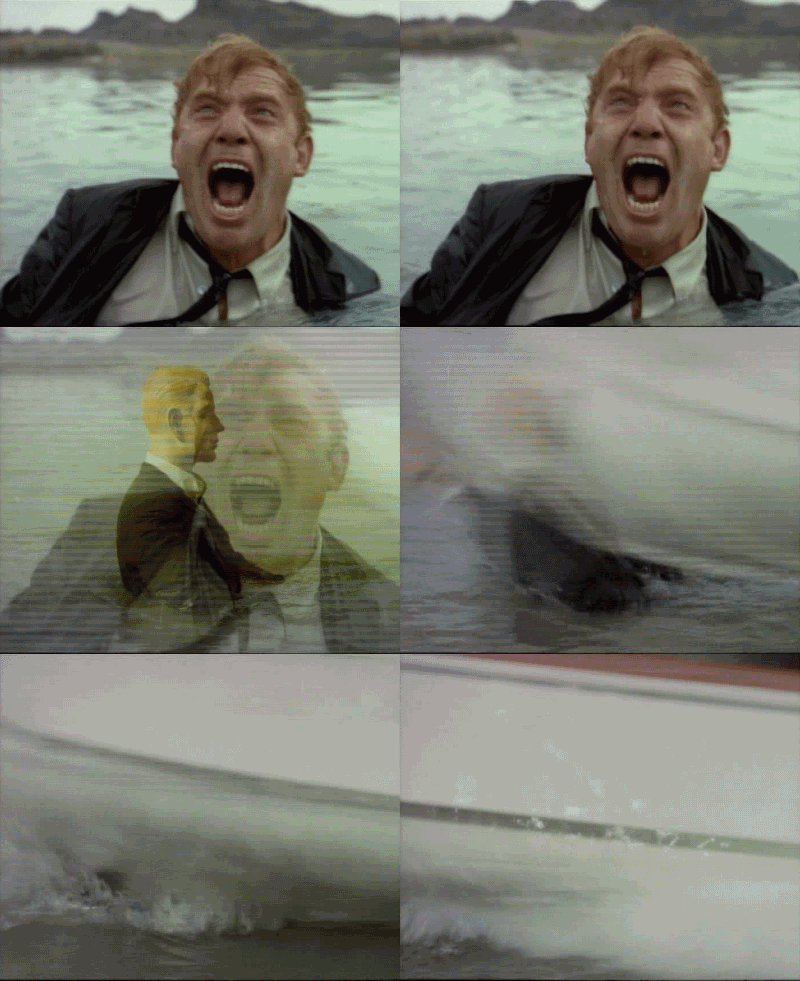
A badly encoded or compressed GIF can result in odd, strangely beautiful phenomena, and with a little skill and coding ability these glitches can be enhanced to enormous proportions. Glitch GIFs break the boundaries of another non-sensuous realm: that of computer code. A significant magical order Benjamin was little capable of predicting.
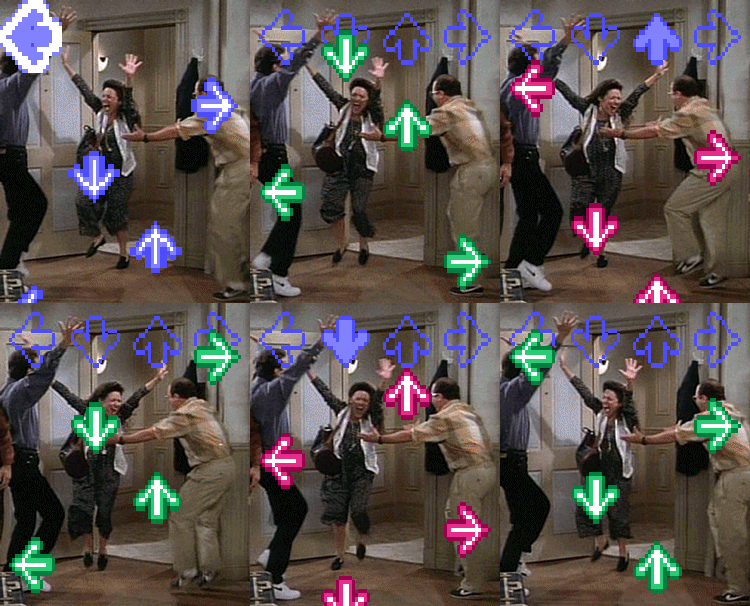
GIF Type V: Mash-Up
Lastly, and perhaps most prolific, is the mash-up GIF. These GIFs are comprised of a combination of all the previous forms. The mash-up is THE most inner-looking species of GIF. It is possible to track the cultural development of some of these. Often though, the source of any original correspondence becomes completely lost in the play of images.
Here again, I think Benjamin’s essay can help us:
“Language is the highest application of the mimetic faculty: a medium into which the earlier perceptive capabilities for recognising the similar had entered without residue, so that it is now language which represents the medium in which objects meet and enter into relationship with each other…”
In other words, what these images MEAN I can’t tell you in words. But perhaps by showing you other GIFs I might go some way to helping you understand them.
This paper was originally delivered at Birkbeck’s, Flash Symposium, 24th May 2011
GIFs sourced from…
I found this one by researching Animated Gif in
Google Scholar.
Although quite short, I think is is quite
interesting for a number of reasons. The reference he has to Walter Benjamin is
basically trying to give credibility to this low art but highly popular digital
cultural phenomenon that refuses to die. So far I am finding little research
and analysis on Animated Gifs, especially in relation to contemporary art.
He gives a brief history of Animated Gifs with some
excellent examples and begins to categories them. The first article that I have
found where gifs have been categorised and timelined.
I have been a fan of Tumblr pages, blogs and Pinterest for a while now and have spent many hours getting sucked into such visual candy. Scanning and scrolling through these pages can be highly addictive as you search for a more perfect image or even better animated gif. One more page, you tell yourself.
But what is this addictive appeal?
Animated Gifs have no sound. They are purely a 1-5
second looped animation, usually related to popular culture. How can some thing
so short and repetitive hold our attention for so long without us getting sick
of it and how do these things have the power to go viral on the Internet?
As Rourke states in his article, most animated gifs
are taken out of context and stand alone as powerful short animations. They
create their own meaning and serve as something highly desirable.
It makes me wonder if today's high technology, fast
paced culture is the reason why animated gifs are so popular. But short looped
animations have been around longer than the gif but I think it is the Internet
that allows for their breakthrough.
So what is it then? Is it human nature to be
attracted to the best bits? Like perhaps the exact funny moment when a baby
panda sneezes?
That moment of being in the right place at the
right time?
Is something so unbelievable we need to see it
again and again?
The power of a chance occurrence.
Are our lives in need of a boost, a laugh, a
giggle, some colour?
Is it like a joke that can be shared easily?
Hello
Hi there.
This is my new blog about my research towards my Masters thesis.
It enables me to start and keep up the reading and writing.
It will include articles, books and other thesis's I have been reading related to my topic which I have posted below.
I welcome any links or discussion.
I am interested in anthropomorphism, wonkiness or wabi sabi, uncanny valley, robotics, humor, animated gifs, animation, mistakes and humor all in relation to art.
This is my new blog about my research towards my Masters thesis.
It enables me to start and keep up the reading and writing.
It will include articles, books and other thesis's I have been reading related to my topic which I have posted below.
I welcome any links or discussion.
I am interested in anthropomorphism, wonkiness or wabi sabi, uncanny valley, robotics, humor, animated gifs, animation, mistakes and humor all in relation to art.
Abstract
GIVE YOUR
MISTAKES A HUG
Encouraging and
enhancing explorative mistakes in a multimedia practice.
ABSTRACT
I
am influenced by artists and popular culture that have
an anthropomorphic, humorous and wonky aesthetic. I want to explore
the relationship between the elements of error, chance, anthropomorphism and
humour in my own practice considering how the connections and relationships
between these elements can be enhanced? Traditionally, errors are
discarded or covered up but I intend to challenge this aesthetic by highlight
them through humour and inturn, make audiences (and myself) more comfortable
with them. In my practice aim to make odd elements work together, be
graphically striking and mix high and low cultural influences and in doing so,
I hope to understand how animation can enhance anthropomorphic qualities and
visual impact. Through an examination of the occurrence and ‘use’ of mistakes,
chance and improvisation within my constructed props used in my
animated films, I question, is such a spontaneous,
improvised and serendipitous process translatable into a highly
scripted and time-consuming process such as animation? Can the uptake
of the unexpected be better facilitated through digital animation and video
processes?
Definitions:
Anthropomorphism
is commonly defined as attributing human characteristics to an animal or
object.
By this definition anthropomorphism has been commonly
applied to non-human characters in diverse media, but whether the extent of
anthropomorphism in art influences its critical reception and empathetic
response by audiences has not been widely discussed. The study of this has
obvious implications for understanding the ways in which artists can exploit
aspects of anthropomorphism to obtain particular audience responses.
Robotics researchers such as Brian Duffy and Masahiro Mori discuss
artificial humans and our critical response to varying degrees of human
characteristics. Mori’s notion of Uncanny Valley forwards that when a character
gets so human-like we no longer see the human similarities and and instead
focus on the faults that make it less than human.[1]
In response, Duffy lists a series of social and anthropomorphic traits that
that can be designed into characters in order for audiences to invest empathy
in them.[2]
Curator Kirsten Anderson suggests that our human need to relate to others is so
strong that, like our ancestors, we are able to visually grasp and empathies
with a character represented in a simplistic manner.[3]
The first beings that
children learn to understand something of are human beings, and especially
their own selves; and the first explanation of all events will be the human
explanation, as though chairs and sticks and wooden horses were actuated by the
same sort of personal will as nurses and children and kittens.[4]
In this extract from Tylor’s Primitive Culture he discusses how from an early age it would seem
that seeing anthropomorphic characteristics within inanimate
objects is instinctual. Tylor also discusses
how ancient ‘primitive’ cultures went beyond the personification of
an inanimate object to projecting spiritual, animistic qualities upon them. ‘ ..What we call inanimate objects rivers,
stones, trees, weapons, and so for they are treated as living intelligent
beings, talked to, propitiated, punished for the harm they do.’[5]
Tylor suggests that Animisim is the the groundwork of the Philosophy of
Religion[6]
suggesting perhaps that the power of anthropomorphism can be traced back to
spiritual, primitive origins.
If
an object can display anthropomorphic qualities then it can
also be argued that an object can seem humorous, as humour is also
one of many human characteristics. Bergson writes, ‘The first point to which attention should be called is that the comic
does not exist outside the pale of what is strictly human. A landscape may be
beautiful, charming and sublime, or insignificant and ugly; it will never be
laughable. You may laugh at an animal, but only because you have detected in it
some human attitude or expression.’[7]
Freud described jokes as: ‘a contrast of ideas’, ‘sense in nonsense’, ‘bewilderment and
illumination’.[8]
Traditionally humour and high art are not regarded as allies.
This changed with the
first act of the Dada group in Zurich at the Cabaret Voltaire,
an outlet from which to criticize the war culture.[9]
The alienation the Dadaists felt from the horrors of the war manifested as an
absurdist type of humour. From there, as Higgie states, humour has been
central to the cultural politics of movements such as Dada, Surrealism,
Situations, Fluxus, Performance and Feminism, and of course
much more recent art practice that’s defies categorization. Indeed,
if humour has a common characteristic, it is to thumb its nose at
pigeonholes.[10]
Mistake is defined as an act or judgement that is misguided or wrong.
Within the craft of using different materials (from
ceramics to animation), there are certain techniques that are taught and
adhered to. I would like to challenge some of these techniques to produce work
that could be seen as traditionally or technically ‘wrong’ or as a mistake.
These will be nurtured and highlighted as a way to challenge stereotypes and
introduce any humour within the media used.
Crude is defined as a
natural or raw state that is unrefined. It can refer to something constructed
in a rudimentary or makeshift way and can sometimes be seen as offensive,
coarse or rude.
The nature of the media being
used will be respectful of its natural state so as not to over complicate the
work on a visual context. This is not to say that the thought process is simple
but has a complex thoughtfulness behind it. A basic, almost instinctual process
of construction will be encouraged.
METHODOLOGY/ RESEARCH
TASKS
I have a background in Industrial Design, Fine Art and Multimedia but the common thread with all my work has been the influence of anthropomorphism and experimentation with various media. This diversity will be reflected in the work I plan to produce, ranging from jewellery, illustration, sculpture, ceramic, video and animation.
I expect theory regarding the answers to these multiple
questions to emerge from research. The animations will have varying degrees of
narrative, so that aspects of anthropomorphism may emerge. It is anticipated
that making of the artwork and the production of the animations will be the main
tasks to be accomplished in undertaking the project.
In conclusion this project will be useful in redefining the capabilities of different media and establishing anthropomorphic appeal. It will also discover and make use of spontaneous and less time consuming animation processes and techniques.
[1] Mori, Masahiro (1970). Bukimi no tani
The uncanny valley (K. F. MacDorman & T. Minato, Trans.). Energy, 7(4),
33–35
[2] Duffy BR,
Anthropomorphism and The Social Robot, Media Lab Europe, Dublin 8, Ireland,
2003
[3] Anderson K, ' Not Just a Contemporary Phenomenon', ibid. pp.111.
[4] Tylor, Edward B. Primitive Culture: Researches Into The Development Of Mythology,
Philosophy, Religion, Art and Customs, pp. 285 Vols. I and II, New York:
Gordon Press (1871 and 1974).
[5] Tylor, Edward B. ibid pp. 477
[6] Tylor, Edward B. ibid pp. 426
[7]
Henri B, ‘Laughter: An
Essay on the Meaning of the Comic ', in The Artists Joke
Edited by Jennifer Higgie, Documents of Contemporary Art, pp. 22, The MIT
Press, Cambridge, 2007.
[8] Freud S, ‘Jokes and Their Relation to the Unconscious', in The Artists Joke Edited by Jennifer Higgie, Documents of Contemporary
Art, pp. 26,7, The MIT Press, Cambridge, 2007
[9]
Kuenzli R, Dada, pp 16, Phaidon Press
Limited, London, UK 2006
[10] Higgie J, ‘The Artists Joke Edited by Jennifer Higgie, Documents of Contemporary
Art, pp. 12, The MIT Press, Cambridge, 2007
Subscribe to:
Posts (Atom)